The Role of Occlusion in Interdisciplinary Comprehensive Care
Dr. Fisher
By: Darell Fisher, DDS
My first exposure to occlusion goes back to 1976 at The Ohio State University. In those early years, Dr. Huffman laid the foundation for what would become a lifelong focus – understanding how occlusion influences not only teeth, but function, stability, comfort and predictability.
My first exposure to occlusion goes back to 1976 at The Ohio State University. In those early years, Dr. Huffman laid the foundation for what would become a lifelong focus – understanding how occlusion influences not only teeth, but function, stability, comfort and predictability.
As I progressed into my general practice residency, I was introduced to Peter Dawson’s courses. That education was later strengthened through the Pankey Institute. Each of these experiences contributed to a clearer understanding that occlusion is not merely “bite adjustment” or “how teeth fit together.” Occlusion is a biological and mechanical system – one that influences the entire stomatognathic complex.
As my interest deepened, I began searching for the periodontal component that must accompany occlusion if we are to truly treat comprehensively. That search brought me to Dr. Paul Ricchetti, who encouraged me to attend the Nevins and Kramer classes in Boston. Those experiences helped connect occlusion to the supporting structures – bone, tissue and attachment – and to the long-term consequences that follow when those relationships are ignored or misunderstood.
The interdisciplinary component expanded. Adding orthodontics with Dr. Michael Sabat and oral surgery with Dr. Eric Fried helped complete the framework. We now have a collaborative team that can integrate restorative dentistry, periodontics, orthodontics and oral surgery – each discipline contributing to a shared goal: improved outcomes with long-term stability.
Whether we are managing an all-tooth-supported dentition, an all-implant-supported dentition or a combination of teeth and implants, we must embrace fundamentals before any definitive treatment decisions are made. And at the center of those fundamentals is occlusion.
Occlusion Starts Before the Teeth
To understand occlusion properly, we must begin by evaluating the entire face – not simply the teeth. Symmetry (or lack of symmetry), skeletal relationships, joint health and muscle function all influence what is possible and what will remain stable over time.
We evaluate the TMJ and range of motion. We assess pain, crepitus, clicking or limitations. We identify parafunctional habits – bruxing, grinding and clenching – and the muscular effects of those habits. We consider airway issues. We evaluate smile dynamics: lips together at rest, repose and full smile. We note tooth display, gingival display and the smile line.
These evaluations are not cosmetic observations – they are diagnostic necessities. They influence the occlusal scheme, the position of teeth, the functional envelope and the long-term success of treatment.
The Occlusal Evaluation: What We Look For
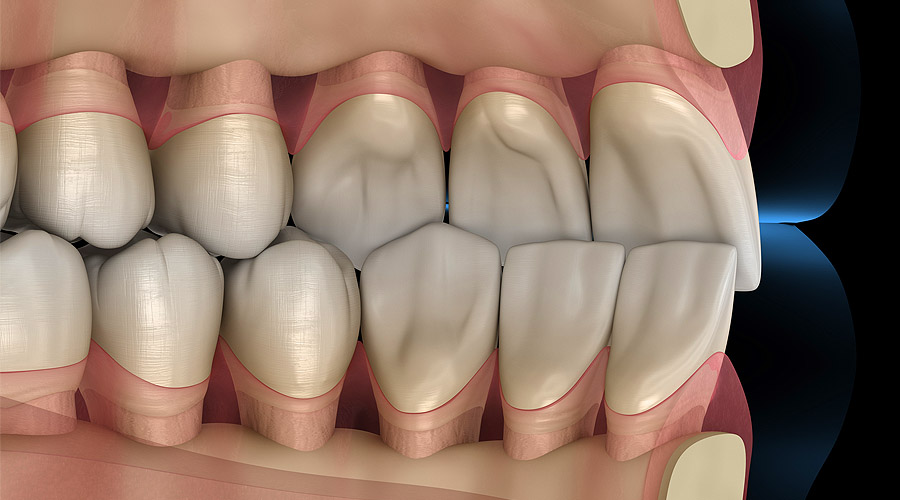
Once the facial and functional foundation is understood, we focus directly on the occlusion. We begin by evaluating the occlusal relationship and looking for a Class I cuspid and molar relationship. In my experience, Class I cuspids are paramount to results and predictable function. When cuspids are not positioned or functioning appropriately, compensations frequently develop elsewhere in the system.
We evaluate centric relation and its relationship to maximum intercuspation. Ideally, centric relation equals maximum intercuspation in a repeatable position, with no prematurities – no “hit and slide.” We want stable centric stops on all teeth, ideally in cusp-fossa contacts that vertically load posterior teeth. We want lighter contact on anterior inclines and no fremitus on anterior teeth.
We evaluate overbite and overjet to establish appropriate anterior guidance. In lateral excursions, we want cuspid guidance discluding all posterior teeth from interferences and, in excursions beyond the cuspid (crossover), we want anterior incisal contact without any posterior interferences. In protrusive movement, the incisors should disclude all other teeth. These principles reduce destructive forces, protect posterior teeth and restorations, and support a stable functional system.
We also evaluate evidence of occlusal dysfunction: wear patterns of incisal edges and cusp tips, wear facets and occlusal breakdown. We assess mobility and distinguish physiologic mobility from pathologic mobility. We identify primary occlusal trauma versus secondary occlusal trauma and evaluate these forces relative to attachment loss and tooth structure loss.
Occlusion is not evaluated in isolation. We must also account for tooth-size discrepancies; tooth proportions (width versus length); rotations, tipping and crowding; irregular incisal edges; and the overall harmony of the arch form. We evaluate arch coordination, the occlusal plane, marginal ridge relationships, cementoenamel junction levels, root alignment, the number of teeth present and the quality of each tooth – individually and collectively.
Teeth, Implants and Combination Dentitions
A critical question today is: How does this differ when we treat all teeth, all implants or a combination of teeth and implants? The answer begins with understanding that teeth and implants behave differently under load. Teeth have periodontal ligament proprioception and physiologic movement. Implants do not. Bone quality, tissue thickness, implant position, occlusal scheme and force direction become even more significant in implant-supported cases.
But regardless of whether we are restoring teeth, implants or both, the same principle holds true: We must evaluate the entire system and design the
occlusion intentionally. When occlusion is ignored, even excellent dentistry can fail. When occlusion is respected, comprehensive interdisciplinary treatment becomes more predictable.
Treatment Planning Is Not “One Size Fits All”
After evaluating these factors and determining their impact, the treatment plan becomes highly specific to the individual patient. It cannot be a one-size-fits-all thought process.
In an interdisciplinary environment, the ability to discuss, visualize and coordinate treatment is invaluable. It clarifies the plan and improves predictability. Many questions cannot be definitively answered without preliminary steps and reevaluation.
The Power of Provisionalization
For me, one of the most significant tools in this process has been provisionalization.
Provisionals answer questions in a definitive way: what we have, what we may need and how we accomplish our initial vision – starting with the end in sight. Provisionals help us test function, esthetics, phonetics, occlusal comfort, patient acceptance and oral hygiene compliance. They allow us to validate the occlusal design before committing to definitive restorations.
However, all of this is futile if the patient’s desired outcome is not determined and accepted from the beginning. When the patient experiences beautiful,
functional provisionalization that matches the desired outcome, they become receptive to the next steps required to achieve the definitive results they seek.
Looking Ahead
In subsequent issues, I plan to expand on how we definitively determine hopeless versus hopeful teeth, what may or may not represent a terminal dentition and how experience can shape bias in these decisions. I will also reflect on what I’ve learned over 46 years – more than 35 with implants – by reviewing documented cases, identifying what worked and what didn’t, and discussing how we might approach similar situations today.
But the foundation of that discussion remains the same: predictable, comprehensive interdisciplinary dentistry in which occlusion is an integral part.