Lessons From the Podium
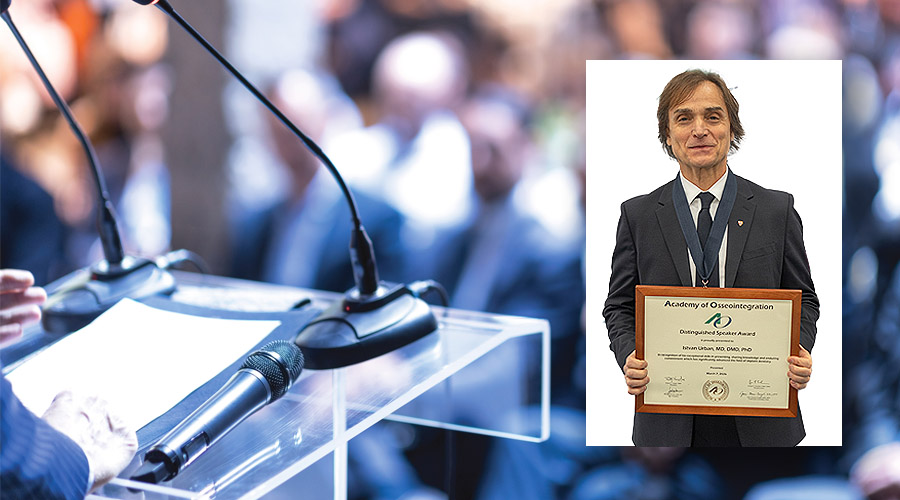
By: Istvan Urban, DMD, MD, PhD
I felt deeply moved and honored when I received the news of being the first recipient of the Distinguished Speaker Award. It does mean a lot to me.
I never planned to be a speaker. Honestly, I did not even know that you could be one. However, I had a strong connection with teaching. When I was in my second year of dental school, I was deeply involved with anatomy. Because that was known among other students, friends of mine – even from medical school – asked me to help them prepare for their anatomy finals. I felt the way I explained anatomy to them helped in understanding areas that were not clear in the book or other lectures. In addition, I really enjoyed doing it. Things that you just had to memorize, I instead wrote poems about, using the initial two- or three-syllable structures of branches of nerves, etc., so that if you learned the poem, you learned the nerve or artery. I found a book that described more than 70 branches of the trigeminal nerve and made a poem out of it. This was a great help for me and my friends.
Later, when I became a clinician, I often thought about how teaching was something that I really enjoyed. I thought I had lost it forever. However, when I became a student at Loma Linda, it was mandatory to give a presentation about the topic of your choice. I chose peri-implantitis, read extensively, ordered audio recordings from an AAP session, and prepared thoroughly. The moment I finished my presentation; I realized that this was for me. Looking at the surprised faces around the room told me the same thing. However, my main goal was still to do great surgery with very thorough documentation. Later, I realized that this meticulous documentation could be used well for my presentations and publications.
Speaking in front of an audience has its challenges. Imagine that you are invited to speak to audiences with very different levels of expertise on the same topic – for example, on the main podium of the AO versus a prosthodontic congress. Add to these different geographic locations with varying language skills. You must mentally prepare for this, and you should be able to constantly read the audience from the beginning. Look into their eyes, register their expressions and adapt without notice. The same title, the same slides, do not mean the same lecture. You have to perform at the audience’s level. The presentation must be not only educational but entertaining as well. This way, no one falls asleep, which is an important part of learning.
A lecture can be made much less effective depending on lighting settings, room temperature and air ventilation. I always check these items before my presentation and ask for any changes I feel are necessary. If the changes are not possible, I accept the situation and adapt rather than start blaming the organization before I even give the lecture. If the clicker does not work, or the timer is not running properly, blame yourself first. I always take my own timer and check the clicker ahead of time if it is not my own. This is similar to when you perform surgery. Don’t blame somebody who did not prepare or clean your patient properly. It is your surgery, your presentation. You own it.
You must find a logical frame in your presentation. You may not need to start by putting slides into the computer, but rather go for a walk and think it over. During the preparation, I take breaks and go for another walk and think about what I still have to add, what does not flow, what is not logical or what needs improvement. Specifically, for short presentations, I recommend practicing and timing it, and removing slides until it fits the time perfectly. In the end, you must realize that preparation – considering all the circumstances – is complex and there is a learning curve. I feel that I could write a book about its complexity.
It is important that when you give a presentation, you make sure that it is on solid ground so you can be confident on the stage, no matter who the audience is and who thinks what. I wish I were as confident in all other aspects of life as I am in my profession. At the beginning, practice in front of your peers to see what they think. However, I never did this, but I think for some it would have been a good idea. If the presentation is dry and boring, few will listen – even to good, valuable information. Do not sacrifice your lecture to satisfy other people’s opinions or some company’s interests. It really takes away from the value. Just do it. The rest will come.