From Hypothesis to Evidence: Emergence Angle and Profile in Peri-Implant Health

Dr. Katafuchi
By: Michitsuna Katafuchi, DDS, MSD, PhD, MBA
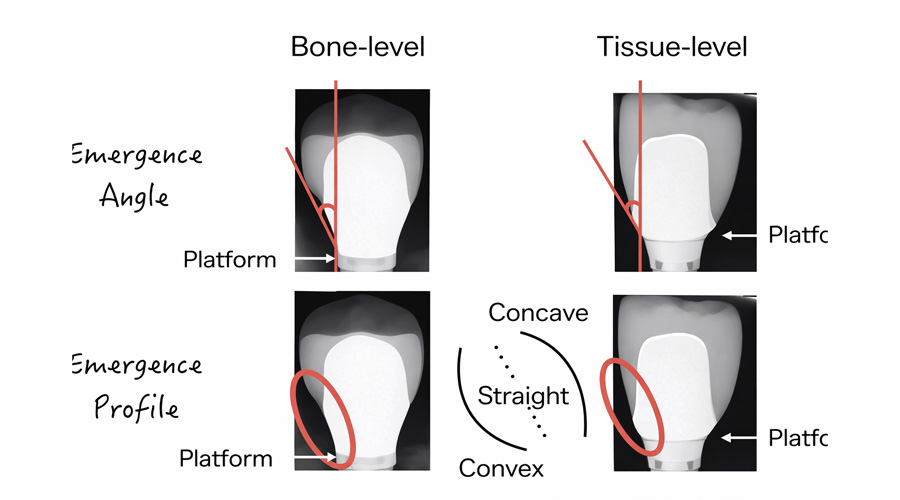
In 2018, we published an article suggesting that restoration contour might be an indicator for peri-implantitis. Clinicians often assume that over-contoured implant restorations negatively affect peri-implant tissues, like how over-contoured fixed dental prostheses impact the tissue around a tooth. At that time, however, only a few case studies supported this relationship,1 and assessing this association was challenging because there was no standardized method to quantify restoration contour.
To address this gap, we explored the concept of emergence angle, defined in the Glossary of Prosthodontic Terms (2005) as the angle of an implant restoration’s transitional contour relative to the implant’s long axis. This metric provides a way to measure how far a restoration extends from the implant. We also examined the more commonly known concept of emergence profile, which describes the contour of a restoration as it relates to adjacent tissue — typically concave, straight, or convex. At the University of Washington’s Periodontics Department, the prevalence of peri-implant disease in a patient cohort was evaluated previously.2 We assessed the relationship between emergence angle/profile and peri-implantitis prevalence using this cohort. Our radiographic analysis
included 83 patients with 168 implants, and the results were noteworthy3:
- For bone-level implants, peri-implantitis prevalence was significantly higher when the emergence angle exceeded 30° compared to ≤30° (31.3% vs. 15.1%, p = .04).
- No such correlation was observed in tissue-level implants.
- When a convex profile was combined with an angle >30°, peri-implantitis prevalence rose to 37.8%, with a statistically significant interaction between angle and profile (p = .003).
This study was later included in the recent AO/AAP systematic review and meta-analysis4,5. It suggests that emergence angle and profile are emerging concepts with potential as risk markers for peri-implantitis. Emergence angles <30° and a concave/ straight emergence profile are linked to decreased periimplantitis risk in bone-level implants.
Why might a wide emergence angle combined with a convex profile negatively affect peri-implant tissue? One explanation is that over-contoured restorations limit hygiene access to the implant body.6,7 Another biologically plausible factor is tissue volume: narrower emergence angles may increase soft tissue height, which previous studies have linked to maintaining peri-implant bone stability.8,9,10
It is essential to categorize implant platforms based on implant-abutment connection when discussing these concepts. There are three major types: tissue-level implants, platform-matched (butt-joint) bone-level implants, and platform-switched bone-level implants.11
Most bone-level implants in our 2018 study were platform-matched. For platform-switched designs, an emergence angle >30° may influence bone levels in the short term, but long-term effects remain unclear.12,13 Given that most current bone-level implants use platform switched systems, further long-term research assessing platform-switched bone-level implants is warranted.
What contributes to a wide emergence angle? Often, it results from implant placement that deviates from the ideal restorative position. This underscores the need for reciprocal feedback between surgical and restorative teams during treatment planning.14 With peri-implantitis affecting approximately 20–22% of patients,4 reducing risk markers is critical. Designing restorations with emergence angles <30° and concave or straight profiles not only lowers risk but also facilitates probing and hygiene access during maintenance.
In my view, every implant placed today may require periimplantitis treatment in the future — possibly by someone other than the original provider. Restoration contour design will influence treatment accessibility as well. As such, emergence angle and profile deserve greater attention for dentists, dental hygienists and lab technicians, in the prevention and management of peri-implant disease and the maintenance of peri-implant health.