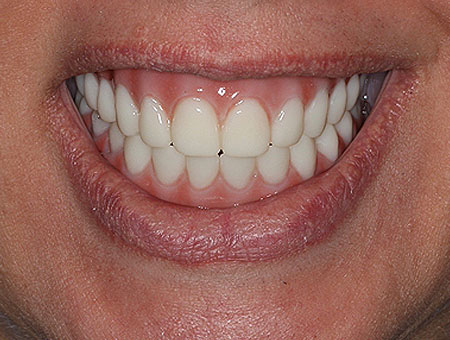
Avoiding the Double Gum in full arch implant therapy with the FP3
By: Xavier E. Saab, DDS, MS; Academy News Guest Contributor
The FP3 is the oldest prosthetic solution for the treatment of edentulism with dental implants as presented by Prof. P.I. Branemark in 1977. It has several advantages over other prosthetic alternatives, but the most remarkable ones are the need for fewer number of implants, and the ability to restore even and symmetric gingival contours, especially when the patient presents with a high or unfavorable lip line.
The need for bone reduction is considered to be one of the disadvantages of this treatment modality. This necessity is usually attributed to the thickness requirements of the prosthetic material used. However, the gingival smile display should play an equal, if not more important role when determining the amount of bone reduction required for adequate prosthetic fabrication.
One of the common complications of the FP3 we encounter is the unesthetic display of the gingival prosthetic transition line when the patient smiles, particularly when restoring the maxilla: the “double gum,” commonly caused by an error in the analysis of the smile, and a lack of adequate bone reduction. A systematic analysis of the smile can help establish the ideal positioning of the prosthetic transition line under the upper lip when the patient expresses the highest possible smile.
When analyzing a terminal dentition, or when establishing a new teeth setup for a complete maxillary prosthesis, we start by establishing the ideal position of the maxillary incisal edges — horizontally, at or behind, the wet-and-dry lip line or vertically, within the range of 0.5-3mm away from the lower lip. Incisal edges that touch the lower lip make the patient look too “toothy,” while incisal edges that are too far from the lower lip can create a reverse or “sad” smile line or occlusal plane. It is important to try to develop a smile line that also follows the shape of that lower lip. This is usually achieved by raising the occlusal plane for more V-shaped lips and lowering the occlusal plane for more square-shaped lips.
Then, the tooth size needs to be selected. Length and shape can be selected according to the patient’s skeletal architecture, size, sex and preference. For maxillary central incisors, a range from 9.5-11.5mm can be considered, or denture tooth molds or databases can also be utilized.
Now we can focus on the position of the gingival scallop in relation to the upper lip. A favorable lip line, which hides the gingival display requires no ridge repositioning for aesthetic purposes. Bone reduction in this case should only be done to comply with minimal prosthetic material thickness.
However, if the patient exhibits an unfavorable lip line where the gingival contours are displayed during the maximum possible smile, the amount of tissue displayed from the zenith of the incisors to the lip position must be measured. If the goal is to position the prosthetic transition line 2-3mm beneath the upper lip, then the calculation for the necessary ridge repositioning, which equals the amount of bone reduction required, would be the sum of the amount of gingival display plus 2-3mm to assure the location of the prosthetic line under the lip.
Finally, with this information we can go to the CBCT and ask the question, if we reduce the amount of bone necessary to hide the prosthetic transition line, is there enough vertical bone left to place our implants? If the answer is yes, we have an ideal case for an FP3. If the answer is no, then we should consider a different prosthetic approach for the rehabilitation of this patient.